
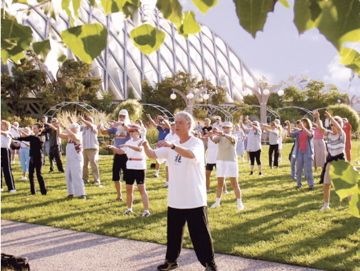
We know that exercise is good for you. We also know that meditation is good for you. What happens when you put those two together?
Yoga, tai chi, and qigong are sometimes called “meditative movement” practices because they include both meditative elements and physical ones.
- Tai chi originated in China as a martial art. It may help to improve balance and prevent falls in older adults, and it may be helpful for some painful conditions, such as low-back pain, fibromyalgia, and knee osteoarthritis.
- Qigong is an ancient Chinese practice that has many different forms. It has not been studied as extensively as yoga or tai chi, but there is evidence that it may help prevent falls and improve symptoms of conditions such as fibromyalgia, chronic obstructive pulmonary disease, and Parkinson’s disease.
- Yoga originated in India and has many forms. It may be helpful for general wellness and for some health problems, such as back and neck pain, menopause symptoms, and anxiety or depression.
Tai Chi: What You Need To Know
What is tai chi?
Tai chi is a practice that involves a series of slow gentle movements and physical postures, a meditative state of mind, and controlled breathing. Tai chi originated as an ancient martial art in China. Over the years, it has become more focused on health promotion and rehabilitation.
Does tai chi help prevent falls?
Tai chi may be beneficial in improving balance and preventing falls in older adults and people with Parkinson’s disease. It is unknown whether tai chi can help reduce falls in people who have had a stroke or people with osteoarthritis or heart failure.
Older Adults
A 2019 review looked at different types of exercise for preventing falls in community-dwelling older people. The duration and frequency of tai chi sessions varied among the studies. Compared to control interventions that were not thought to reduce falls, there was low-certainty evidence that tai chi may reduce the rate of falls by 19 percent (based on 7 studies with 2,655 participants) and high-certainty evidence that tai chi may reduce the number of people who experience falls by 20 percent (based on 8 studies with 2,677 participants). Other forms of exercise were also helpful. The authors found high-certainty evidence that balance and functional exercises—exercises that are similar to everyday actions like rising from a chair, stepping up, or rotating while standing—could reduce the rate of falls by 24 percent (based on 39 studies with 7,920 participants) and lower the number of people experiencing one or more falls by 13 percent (based on 37 studies with 8,288 participants).
Parkinson’s Disease
A 2021 review analyzed three studies of tai chi’s effect on falls in people with Parkinson’s disease. The 3 studies included a total of 273 participants who did 60-minute tai chi sessions two to three times per week for 12 weeks to 6 months. The analysis indicated that tai chi had a significant positive effect on reducing falls when compared with both no intervention and different interventions like resistance training and stretching.
A 2020 summary of three reviews that included some relevant studies found that tai chi may help improve balance and reduce falls in people with Parkinson’s disease, but the certainty of the evidence was considered to be low.
Stroke
A 2018 review evaluated 5 randomized controlled trials with 346 participants who had experienced a prior stroke. (Randomized controlled trials are studies in which participants are randomly assigned to an intervention group and control group.) Tai chi sessions were typically 60 minutes long and done two to three times weekly for 6 or 12 weeks. The review found that tai chi helped to improve the participants’ walking gait in the short term but not their balance when they stand and move their upper body outside their center of gravity, such as reaching forward as much as possible while in a fixed standing position. The authors of the review said that all of the studies had high bias and were small and that large, long-term randomized controlled trials are needed to confirm the review’s findings.
Osteoarthritis
A 2015 review included 9 osteoarthritis studies with a total of 543 participants. The review concluded that tai chi improved pain and stiffness in osteoarthritis, and the authors noted that the improvement may increase balance. Updated 2019 guidelines from the American College of Rheumatology and the Arthritis Foundation strongly recommend tai chi for the management of both knee and hip osteoarthritis.
For more on the research behind Tai chi see
https://www.nccih.nih.gov/health/tai-chi-what-you-need-to-know?nav=govd
Qigong: What You Need To Know
What is qigong and how does it work?
Qigong, pronounced “chi gong,” was developed in China thousands of years ago as part of traditional Chinese medicine. It involves using exercises to optimize energy within the body, mind, and spirit, with the goal of improving and maintaining health and well-being. Qigong has both psychological and physical components and involves the regulation of the mind, breath, and body’s movement and posture.
In most forms of qigong:
- Breath is slow, long, and deep. Breath patterns may switch from abdominal breathing to breathing combined with speech sounds.
- Movements are typically gentle and smooth, aimed for relaxation.
- Mind regulation includes focusing one’s attention and visualization.
Dynamic (active) qigong techniques primarily focus on body movements, especially movements of the whole body or arms and legs. Meditative (passive) qigong techniques can be practiced in any posture that can be maintained over time and involve breath and mind exercises, with almost no body movement.
Is qigong the same as tai chi?
Tai chi is one of the hundreds of forms of qigong exercises that were developed in China. Other forms of qigong include Baduanjin, Liuzijue, Hu Yue Xian, Yijin Jing, and medical qigong.
Can qigong reduce pain?
The research on qigong’s role in pain is conflicting. Three reviews from 2018 and 2019 that looked at only a small number of studies suggested that qigong may help to decrease pain in community-dwelling older adults (160 participants), neck pain (525 participants), and musculoskeletal pain in people 15 to 80 years old (1,787 participants). But a 2020 review that included 5 studies (576 participants) found conflicting results on qigong’s pain-reducing effects for low-back pain and neck pain.
Is qigong helpful for people with chronic diseases?
Fibromyalgia
Frequent and consistent qigong practice may be helpful for people with fibromyalgia in areas like pain, sleep, and physical and mental function. This, however, is based on initial research that includes only a few small studies.
- A 2020 review looked at two small studies of qigong’s effects on people with fibromyalgia. The first study, which included 89 people, found that 6 months of qigong practice helped with pain, sleep quality, and physical and mental function. The second study, which included 57 people, found that 7 weeks of qigong practice resulted in decreased pain, less inconvenience from fibromyalgia, decreased anxiety, and improved quality of life.
- A 2017 review with 4 studies on qigong for fibromyalgia (201 participants) found that the amount of time people practice qigong made a difference. People with fibromyalgia who did diligent qigong practice—30 to 40 minutes daily for 6 to 8 weeks—experienced consistent benefits in pain, sleep, and physical and mental function. These benefits were still seen 4 to 6 months after the studies had completed.
Two small clinical trials (2019, 2020; total of 82 participants) that were not included in the above reviews also found similar positive results of qigong practice in people with fibromyalgia.
Chronic obstructive pulmonary disease (COPD)
A small amount of research suggests that using qigong as a complementary therapy may help with depression, anxiety, lung function, and physical function in people with COPD.
- A 2020 review of 31 studies (3,045 participants) looked at the effect of adding qigong to a primary treatment, such as drug therapy and respiratory training. The review found that adding qigong to the primary treatment helped improve lung function, quality of life, and ability to exercise in people with COPD.
- A 2019 review of 6 studies (415 participants) found that qigong reduced self-ratings of depression and anxiety in people with COPD when qigong was combined with standard treatment. The qigong programs lasted from 2 to 6 months.
- Another 2019 review found that 3 months of yoga, qigong, or tai chi helped improve lung function and the capacity for walking and physical activity in people with COPD. Twelve of the 18 studies focused on qigong and tai chi, either alone or combined. The programs ranged from 6 weeks to 6 months and included 30- to 90-minute sessions two to seven times a week.
For more research about Qigong see:
https://www.nccih.nih.gov/health/qigong-what-you-need-to-know?nav=govd
Yoga: What You Need To Know
What is yoga and how does it work?
Yoga is an ancient and complex practice, rooted in Indian philosophy. It began as a spiritual practice but has become popular as a way of promoting physical and mental well-being.
Although classical yoga also includes other elements, yoga as practiced in the United States typically emphasizes physical postures (asanas), breathing techniques (pranayama), and meditation (dyana).
There are many different yoga styles, ranging from gentle practices to physically demanding ones. Differences in the types of yoga used in research studies may affect study results. This makes it challenging to evaluate research on the health effects of yoga.
Yoga and two practices of Chinese origin—tai chi and qigong—are sometimes called “meditative movement” practices. All three practices include both meditative elements and physical ones.
What are the health benefits of yoga?
Research suggests that yoga may:
- Help improve general wellness by relieving stress, supporting good health habits, and improving mental/emotional health, sleep, and balance.
- Relieve low-back pain and neck pain, and possibly pain from tension-type headaches and knee osteoarthritis.
- Help people who are overweight or obese lose weight.
- Help people quit smoking.
- Help people manage anxiety or depressive symptoms associated with difficult life situations.
- Relieve menopause symptoms.
- Help people with chronic diseases manage their symptoms and improve their quality of life.
Although there’s been a lot of research on the health effects of yoga, many studies have included only small numbers of people and haven’t been of high quality. Therefore, in most instances, we can only say that yoga has shown promise for particular health uses, not that it’s been proven to help.
What does research show about yoga for wellness?
Studies have suggested possible benefits of yoga for several aspects of wellness, including stress management, mental/emotional health, promoting healthy eating/activity habits, sleep, and balance.
More
- Stress management.
- A 2020 review of 12 recent studies (672 total participants) of a variety of types of yoga for stress management in healthy adults found beneficial effects of yoga on measures of perceived stress in all the studies.
- Of 17 older studies (1,070 total participants) of yoga for stress management included in a 2014 review, 12 studies showed improvements in physical or psychological measures related to stress.
- Mental/emotional health. In a recent review of 14 studies (involving 1,084 total participants) that assessed the effects of yoga on positive aspects of mental health, most found evidence of benefits, such as improvements in resilience or general mental well-being.
- Promoting healthy eating/activity habits. A 2018 survey of young adults (involving 1,820 participants) showed that practicing yoga regularly was associated with better eating and physical activity habits. In interviews, people who took the survey said they thought yoga supported healthier habits through greater mindfulness, motivation to participate in other forms of activity, and eating healthier. In addition, the yoga community itself was characterized as a social circle that encouraged connection, where healthy eating was commonplace.
- Sleep. Yoga has been shown to be helpful for sleep in several studies of cancer patients, women with sleep problems, and older adults and in individual studies of other population groups, including people with arthritis and women with menopause symptoms.
- Balance. In a 2014 review, 11 of 15 studies (688 total participants) that looked at the effect of yoga on balance in healthy people showed improvements in at least one outcome related to balance. An additional study, published in 2016, showed that both yoga and stretching-strengthening exercises were effective in improving balance (as well as strength and flexibility) in healthy, previously sedentary older adults.
Can yoga help with pain management?
Research has been done on yoga for several conditions that involve pain. Studies of yoga for low-back pain and neck pain have had promising results, and yoga is among the options that the American College of Physicians recommends for first-line treatment of chronic low-back pain. Preliminary evidence suggests that yoga may also be helpful for tension headaches and knee osteoarthritis pain.
More
- Low-back pain.
- A 2020 report by the Agency for Healthcare Research and Quality evaluated 10 studies of yoga for low-back pain (involving 1,520 total participants) and found that yoga improved pain and function in both the short term (1 to 6 months) and intermediate term (6 to 12 months). The effects of yoga were similar to those of exercise.
- The American College of Physicians recommends using nondrug methods for the initial treatment of chronic low-back pain. Yoga is one of several suggested nondrug approaches.
- Neck pain. A 2019 review of 10 studies (686 total participants) found that practicing yoga reduced both the intensity of neck pain and disability related to neck pain and improved range of motion in the neck.
- Headaches. A 2020 review of 6 studies (240 participants) of yoga for chronic or episodic headaches (tension-type headache or migraine) found evidence of reductions in headache frequency, headache duration, and pain intensity, with effects seen mostly in patients with tension-type headache rather than migraine. Because of the small numbers of studies and participants, as well as limitations in the quality of the studies, these results should be considered preliminary.
- Knee osteoarthritis.
- A 2019 review of 9 studies (640 total participants) showed that yoga may be helpful for improving pain, function, and stiffness in people with osteoarthritis of the knee. However, the number of studies was small, and the research was not of high quality.
- A 2019 guideline from the American College of Rheumatology and the Arthritis Foundation conditionally recommended yoga for patients with knee osteoarthritis based on similarities to tai chi, which has been better studied and is strongly recommended by the same guideline.
For more about the research behind Yoga see:
https://www.nccih.nih.gov/health/yoga-what-you-need-to-know?nav=govd