
Barefoot Doctor's Journal
Take control of your health with this guide to natural health and healing. Get expert advice to help you alleviate pain and live healthy naturally. Access to tools, information and opportunities.
Take control of your health
For 5000 years Traditional Chinese Medicine has help people to relieve pain and achieve a healthy longevity naturally.
A comprehensive guide to natural health and healing, the Barefoot Doctor’s Journal seeks to empower it's readers to take control of their own health, find their own inspiration, help create healthier communities and share the adventure with whoever is interested. Internationally recognized experts in the fields of healthy aging and Traditional Chinese Medicine, the Living Younger Longer Institute has helped hundreds of people each year to live healthy naturally.
News You Can Use!
Providing members with the latest scientific research on the ancient healing secrets of Traditional Chinese Medicine. Get information, access to tools, and enjoyable opportunities for a lifetime of active adventure!
October is Health Literacy Month
Health Literacy Month is a time to promote the importance of understandable health information. Why is it important to know the science of health? Simply put, because there is a lot of misinformation out there and people are dying because of it. From anecdotes disguised as evidence to excessive claims made by supplement manufacturers to TV preachers and doctors touting the latest “miracle cure.” In this edition of the Barefoot Doctor’s Journal, you’ll find tools to help you better understand complex scientific topics that relate to health research so that you can be discerning about what you hear and read and make well-informed decisions about your health. Read about advice from the National Institutes of Health designed to help people understand how scientific research works, how to find accurate, reliable information online, and enjoy the interactive learning exercises in the Know The Science Toolkit.
How Research Works
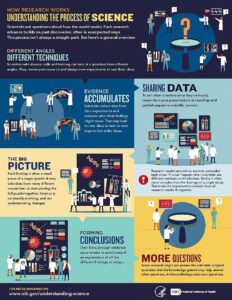
Have you ever wondered what it means to “follow the science?” Sometimes it may seem like what’s true one day changes the next. But when what we know changes, it often means science is working.
Research helps us understand the world through careful testing. Each advance builds on past discoveries. This process can take a long time. But the end result is a better understanding of the world around us.
In general, the scientific process follows many steps. First, scientists start with a question. They look at past research to see what others have learned. Different scientists have diverse skills and training. They each bring their own approaches and ideas. And they design new experiments to test their ideas.
Next, scientists perform their experiments and collect data. Then, they evaluate what their findings might mean. This often leads them to new questions and ideas to test.
The next step is to share their data and ideas with other scientists. Other experts can give new perspectives or point out problems.
It’s natural to want answers. But it’s important not to draw conclusions based on a single study. Scientists start to form conclusions only after looking at many studies over time. Sometimes, even these conclusions change with more evidence. Science is an evolving process. But it’s the best way we have to seek out answers.
(more…)
Integrative Medicine and Cancer Treatment
Integrative Oncology: Evidence-based Medicine meets Patient-Centered Care
Increasingly integrative medicine approaches are being used to support patient health during the ordeal of cancer treatment. Practices like acupuncture, Tai Chi, Yoga, meditation have been found to be extremely useful in managing the symptoms and side effects of many cancer treatments. The September Grand Rounds at the Osher Center for Integrative medicine at Harvard Medical school featured Dr. Jun Mao, Chief of Integrative Medicine at Memorial Sloan Kettering Cancer Center his lecture helps to define integrative oncology and highlight key therapeutic approaches. He will discuss the use of rigorous research that has informed the evidence base for integrative oncology. Additionally, Dr. Mao will detail the application of integration oncology practices in patient-centered care.
(more…)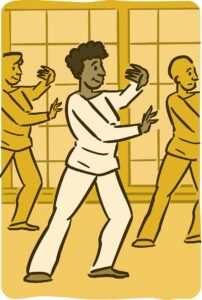
Tai Chi and Your Health
A Modern Take on an Ancient Practice from the National Institutes of Health
You may have seen the flowing postures and gentle movements of tai chi and wondered what it’s all about. Tai chi is an ancient mind and body practice. While more research is needed, studies suggest that it may have many health benefits.
Tai chi is sometimes referred to as “moving meditation.” There are many types of tai chi. They typically combine slow movements with breathing patterns and mental focus and relaxation. Movements may be done while walking, standing, or sitting.
“At its root, tai chi is about treating the whole person and enhancing the balance and crosstalk between the body’s systems,” says Dr. Peter Wayne, a longtime tai chi researcher at Harvard Medical School. “It’s a promising intervention for preserving and improving many areas of health, especially in older adults.”
Several studies have found evidence that tai chi can increase balance and stability in older people and reduce the risk and fear of falls. Each year, more than 1 in 4 older adults falls, and 1 out of 5 of these falls causes a serious injury such as broken bones or a head injury.
“Trying to be careful can make you more prone to falls,” Wayne says. “Tai chi may help you move more confidently and safely again.” Some NIH-funded research suggests that tai chi may also improve balance and prevent falls in people with mild-to-moderate Parkinson’s disease.
Research suggests that practicing tai chi might help improve posture and confidence, how you think and manage emotions and your quality of life. Studies have found that it may help people with fibromyalgia sleep better and cope with pain, fatigue, and depression. Regular practice may also improve the quality of life and mood in people with chronic heart failure or cancer. Older adults may find that tai chi can help improve sleep quality and protect learning, memory, and other mental functions.
Read more and watch the video from Shin Lin of the University of California at Irvine
(more…)
Better Nutrition Every Day
How to Choose Healthier Foods and Drinks
En españolSend us your comments(link sends e-mail)
We make countless decisions every day, both big and small. When it comes to deciding what to eat and feed our families, it can be a lot easier than you might think to make smart, healthy choices. It takes just a little planning.
The foods and drinks we put into our bodies are our fuel. They provide us with energy and nutrients—like vitamins, minerals, and proteins—that our bodies need to function and thrive. Research shows that healthy food and drink choices are especially important for children’s growing bodies and minds. Healthy choices have both immediate and long-lasting benefits for you and your family.
“My best advice is for parents to be good role models by eating healthy and being physically active with their children,” says Dr. Holly Nicastro, a nutritionist at NIH. “Keep healthy foods around the house for meals and snacks. Involve children in the meal planning and cooking, and they will be more likely to eat the meals.”
“Parents can begin teaching their children about healthy eating from the day they are born,” says Dr. Donna Spruijt–Metz, whose research at the University of Southern California focuses on preventing and treating obesity in minority youth. “Setting a good example is very important.”
Healthier Choices and Nutrient Density
All foods and drinks can fit into a healthy diet. But when making choices for you or your family, try to choose ones that have lots of nutrients and aren’t too high in sugar, fats, and calories. These include fruits; vegetables; whole-grain cereals, bread, and pasta; milk, yogurt, and other dairy products; fat-trimmed and lean meats; fish; beans; and water.
Some foods and drinks should be consumed less often. These include white bread, rice, and pasta; granola; pretzels; and fruit juices. Others are best to have only once in a while—like french fries, doughnuts and other sweet baked goods, hot dogs, fried fish and chicken, candy, and soda.
“Healthier diets don’t have to cost more, provided that you have the right attitude, make the right food choices, and try to cook at home,” says Dr. Adam Drewnowski, a nutrition expert at the University of Washington in Seattle. With some planning, he says, you can prepare meals that are tasty, affordable, and nutrient-rich.
(more…)
Physical Activity Can Ease Depression

When you are physically active your brain releases a neurotransmitter hormone called nor-epinephrine, “the happiness and contentedness hormone”. This is part of how the brain regulates its own moods. We were designed to live an active vigorous life, and when we do, we feel better, sleep better, have more energy, and scientists are finding that we can also use exercise as medicine as an important component in the treatment of depression.
Researchers found that how much sleep you get, how much energy you have, and how much physical activity you do can affect feelings of depression. The findings suggest that physical activity may improve your mood and sleep.
Physical activity can help improve your health and quality of life. Not getting enough can increase your risk for some diseases and mental health issues.
A research team looked at the relationship between sleep, physical activity, energy, and people’s moods. They collected data about physical activity and sleepover two weeks using devices worn around the wrist.
Participants used mobile devices to rate their mood and energy levels four times a day. Ratings ranged from “very happy” to “very sad” for mood and “very tired” to “very energetic” for their energy levels. They also rated their sleep and daily activities.
The team found that physical activity improved people’s moods later in the day. The effect was even larger for those with bipolar disorder, a mood disorder that has periods of feeling extremely “up” to feeling very “down” and depressed. Physical activity also made people feel more energetic and affected their sleep.
(more…)